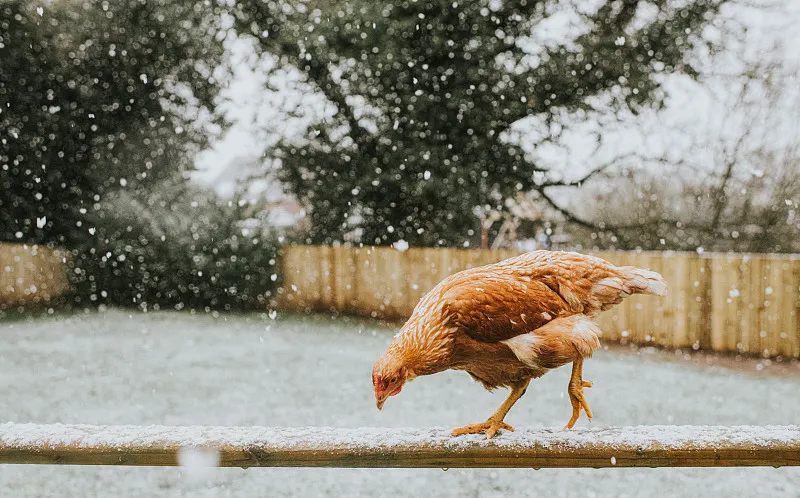
Every winter, the same warning reaches poultry farms from the North China Plain to the Gulf coast and the African highlands: temperatures fell overnight, and by the third morning the houses are full of sneezing, coughing birds. Producers call it “a cold”, and treat it as one. But a sudden temperature drop does not infect a flock — it dismantles the defenses that normally keep poultry respiratory disease out of the airway. Cold stress in poultry is only the trigger; the pathogens were already there, waiting for the barrier to fail. Understanding that sequence is what separates a flock that recovers in a week from one that loses birds for a month. VIBOV EZee BREATH was designed for exactly that moment in the sequence.
Why a Sudden Cold Snap Hits Poultry So Hard
A chicken maintains a body temperature near 41°C, and it does so with very little thermal buffer. When house temperature drops five degrees in a single night — a common swing in continental winters, and in desert climates where day and night diverge sharply — the bird responds within minutes: it fluffs its feathers, huddles, cuts activity and raises feed intake to burn more energy for heat. That response keeps the bird alive, but it is expensive. In poultry, thermoregulation and immune function draw on the same energy pool, so energy redirected to keeping warm is energy no longer available for immune cell production and mucosal repair [2].
The second effect is more local and more damaging. Cold drives blood flow away from the body surface and the upper airway, and it suppresses the local defenses of the tracheal mucosa. In a controlled trial, broilers exposed to 24 hours of acute cold stress — a drop from 20°C to 7°C — showed reduced immunity in the tracheal mucosa [3]. Cold exposure also triggers oxidative stress and heat-shock protein responses that set off low-grade inflammation and further weaken the respiratory lining [2]. The mucociliary escalator, the layer of mucus and cilia that sweeps dust and microbes out of the airway, slows down. Mucus thickens, and the barrier becomes permeable to whatever the bird inhales.
Farm management usually adds a second stressor at the same moment. To hold heat, producers close vents and cut ventilation; ammonia and humidity climb, litter stays wet, dust rises. The flock is then cold-stressed and air-quality-stressed at once, on the most vulnerable surface it has.

Cold Stress Is Only the Trigger: The Real Battle Happens in the Airway
Official veterinary guidance describes the winter-spring pattern in plain terms. In cold, damp weather with wide day-night temperature swings, poultry enter a season dominated by respiratory syndromes — laboured breathing, coughing, sneezing, ocular and nasal discharge — accompanied by falling egg production and higher mortality in young stock. The organisms involved are well known: H9 and H6 avian influenza, infectious bronchitis, avian metapneumovirus, infectious coryza and Riemerella anatipestifer infection, frequently in combination [1].
H9 is the clearest illustration of why “trigger” is the right word. On its own, H9 usually produces mild signs, yet it is immunosuppressive: it damages the respiratory mucosa and the immune barrier, which makes co-infection or secondary infection with infectious bronchitis virus, Mycoplasma, Avibacterium paragallinarum or metapneumovirus far more likely. In layers the result is a fall in laying rate and poorer shell quality; in broilers, respiratory lesions and rising mortality [1]. Field data tell the same story: experimental H9 infection alone rarely kills, with mortality typically below 6%, while natural outbreaks on farms commonly run from 5% to 30%, depending on co-infections, vaccination status and management [4]. Cold stress pushes an outbreak toward the upper end of that range, because it both suppresses immunity and predisposes birds to secondary bacterial complications [4].
That is what actually happens inside the bird. Inflammation thickens the mucus; thick mucus plugs the smaller airways and air sacs; bacteria that would normally be cleared settle and multiply in the lung; and the antibiotics given to control them meet a wall of secretions before reaching the tissue where the infection sits. A bird does not catch a cold the way a person does. It loses a barrier, and that barrier loss is the disease event.
What a Cold-Stressed Flock Looks Like on the Farm
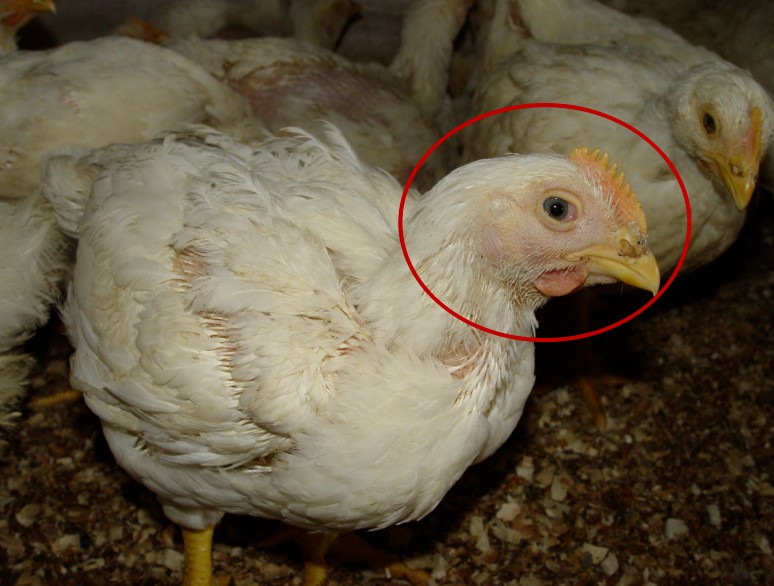
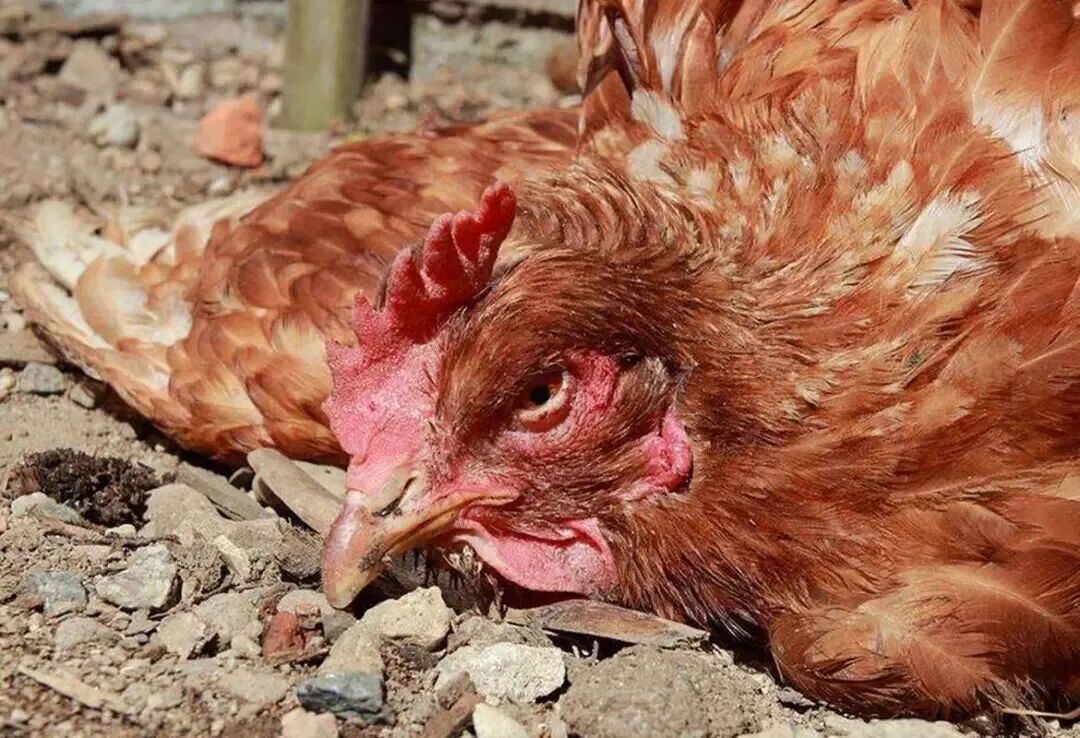
The window for cheap intervention is short, and it opens before the flock looks seriously ill. Early in a cold snap, watch for clear nasal discharge and occasional sneezing, watery eyes, ruffled feathers and birds crowding under the heat source, a small drop in feed and water intake and, in layers, a dip in the laying rate with paler or thinner shells. At night, when the house is quiet, respiratory rales are far easier to hear than in daylight.
The dangerous transition is equally easy to recognize. When nasal discharge turns thick and yellow-green, when birds breathe with an extended neck or gasp, when facial swelling appears and mortality starts to climb in chicks and young birds, pneumonia and airsacculitis are already established. At that point the flock needs a veterinarian and a treatment plan, not another day of waiting. The economics are blunt: a respiratory support programme started at the clear-discharge stage costs a fraction of what a house loses once weight gain, egg output and birds are gone.

Why Treating the Pathogen Alone Is Not Enough
Two mistakes account for most of the losses in a cold snap. The first is treating only the pathogen and ignoring the mucus. The second is waiting for a laboratory result before doing anything at all, while the airway fills.
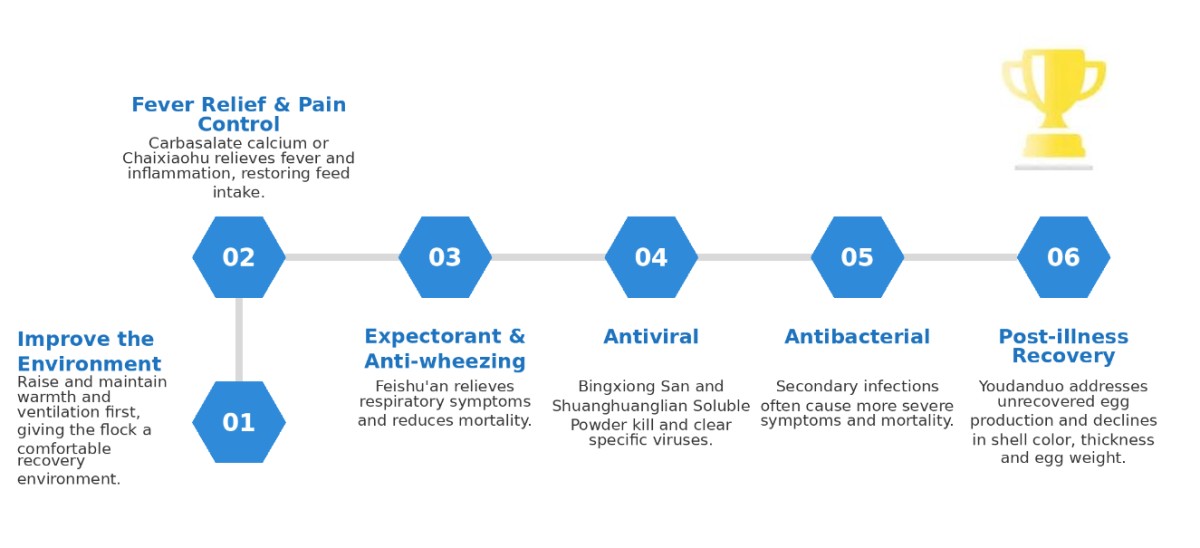
Respiratory therapy works in a sequence, and the sequence has been understood for a long time. Traditional Chinese veterinary practice treats respiratory disease by resolving phlegm and opening the airway first, then addressing the pathogen. Modern respiratory medicine follows the same order: a mucolytic expectorant thins viscous secretions so they can be expelled, the airway reopens, mucociliary clearance resumes, and antibacterial treatment can finally reach infected lung tissue in a concentration that matters. A mucolytic is not a substitute for a correct diagnosis or for antimicrobial therapy where it is indicated. It is what allows that therapy to work, and it is what buys the bird time.
How VIBOV EZee BREATH Fits Into a Cold-Weather Programme
VIBOV has spent 15 years in the research, development, production and international trade of feed additives. It is a national high-tech enterprise and a member of the China Feed Industry Association, with business in more than 80 countries and regions across Asia, Europe, the Americas and Africa, serving over 3,000 large-scale breeding companies and feed groups [6]. Its stated position is antibiotic reduction: natural solutions that keep flocks productive without adding to resistance pressure — a position that matters most in exactly the kind of outbreak where antimicrobials alone fall short. VIBOV EZee BREATH is a mucolytic expectorant in oral liquid form. It fluidifies mucoid secretions in the respiratory tract, especially in the lung after respiratory infection, and supports their expulsion from the airways. It is used as supportive treatment alongside antibacterial therapy in CRD, CCRD, pneumonia and other respiratory diseases, and it improves the absorption of antibiotics in infected lung tissue by thinning thick mucus and helping the bird clear it [5]. In the H9 and infectious bronchitis cases that dominate the cold season, the product is used over five to seven days [5]. It is formulated for poultry, pigs, cattle, horses, sheep and goats, which makes it practical on mixed farms and for distributors serving several species. The application pattern is deliberately simple, because in a cold snap speed matters more than sophistication. For general prevention, 1 ml is added to 4 L of drinking water; for treatment, 1 ml to 2 L; for rapid relief of respiratory symptoms, an aerial spray of 100 ml in 20 L of water applied with a fine nozzle or an aerosol generator is recommended. It is given twice weekly or as needed during the risk period. It should not be used at the same time as live vaccines, and it is withdrawn before live vaccination. Sealed shelf life is three years, which lets distributors in distant markets hold stock through the season [5].
The Other Half of the Programme: Environment, Water and Vaccination
A mucolytic buys time; management decides whether that time is used well. Three things matter most during a cold snap. First, temperature stability rather than temperature ambition: pre-heat the house before a forecast front arrives, read the thermometer at dawn when the house is coldest, and fix the drafts that chill one corner of the shed while the rest stays comfortable. Second, air quality with heat retained: ventilate in short cycles instead of sealing the house, because ammonia and wet litter damage the very mucosa the cold has already weakened. Third, water discipline: medicated water only works if birds drink it, so keep drinkers clean, check flow rates, and match stock solution strength to real daily intake rather than to a number on a label.
Vaccination deserves its own line. Cold-season outbreaks are often blamed on the weather when the underlying problem is a vaccine strain that no longer matches the field virus, an incomplete programme, or an immune gap nobody measured. Review the programme before winter, monitor antibody levels, and observe the product interaction rule:
EZee BREATH is withdrawn before live vaccination, never given alongside it [5].

Conclusion: Protect the Barrier Before the Front Arrives
Cold weather is not a disease, and it is not a mystery. It is a predictable event that removes a barrier, and the outcome depends on how quickly that barrier is restored and how well the airway is kept clear. Producers who act at the first clear nasal discharge — supporting mucus clearance, holding house temperature steady, keeping litter dry and water intake up — lose far less than those who wait for the first gasp.
VIBOV EZee BREATH turns that early action into something concrete: a mucolytic that opens the airway, supports antibacterial treatment and helps a cold-stressed flock breathe through the hardest weeks of the year. Contact VIBOV for technical guidance, dosing support and distributor terms before the next cold front arrives.