
------News Center
Failure to Thrive and Morning Coughs: An In-Depth Review of a Finisher Pig Mycoplasma Case
添加时间:Sep 24, 2026
Porcine Mycoplasma Pneumonia (PMP), also known as swine enzootic pneumonia, remains one of the most prevalent and economically destructive chronic respiratory diseases in global commercial pig farming. Unlike acute swine diseases with obvious high fever and acute death symptoms, mycoplasma infection in finisher pigs often presents with atypical, insidious clinical signs, leading to long-term misjudgment and delayed intervention by farmers. The most typical hidden symptoms include normal feed intake but stunted growth and persistent early-morning dry cough, which cause continuous reduction of feed conversion rate, prolonged fattening cycle, and significant loss of breeding profits.
This article conducts an in-depth case review of a typical mycoplasma infection case in commercial finisher pigs, systematically analyzes the clinical manifestations, pathological changes, outbreak causes, and treatment difficulties of the disease. Meanwhile, it verifies the efficient prevention and treatment effects of Vibov professional swine mycoplasma control products in practical breeding scenarios, providing scientific, replicable, and high-efficiency solution support for global pig farms to solve hidden respiratory health problems and improve breeding economic benefits.
1. Case Background and Clinical Manifestations
The case occurred in a 1200-head commercial finisher pig farm in Eastern China, with breeding standards in line with global medium and large-scale pig farm management norms, and standardized feeding and daily ventilation management. The affected pigs were 14–16 weeks old finishers in the rapid fattening stage. In the early stage of the disease, the farm staff found no obvious abnormal symptoms such as fever, lethargy, or decreased appetite. All infected pigs maintained normal feeding and drinking behaviors, which made the disease easily overlooked in daily health checks.
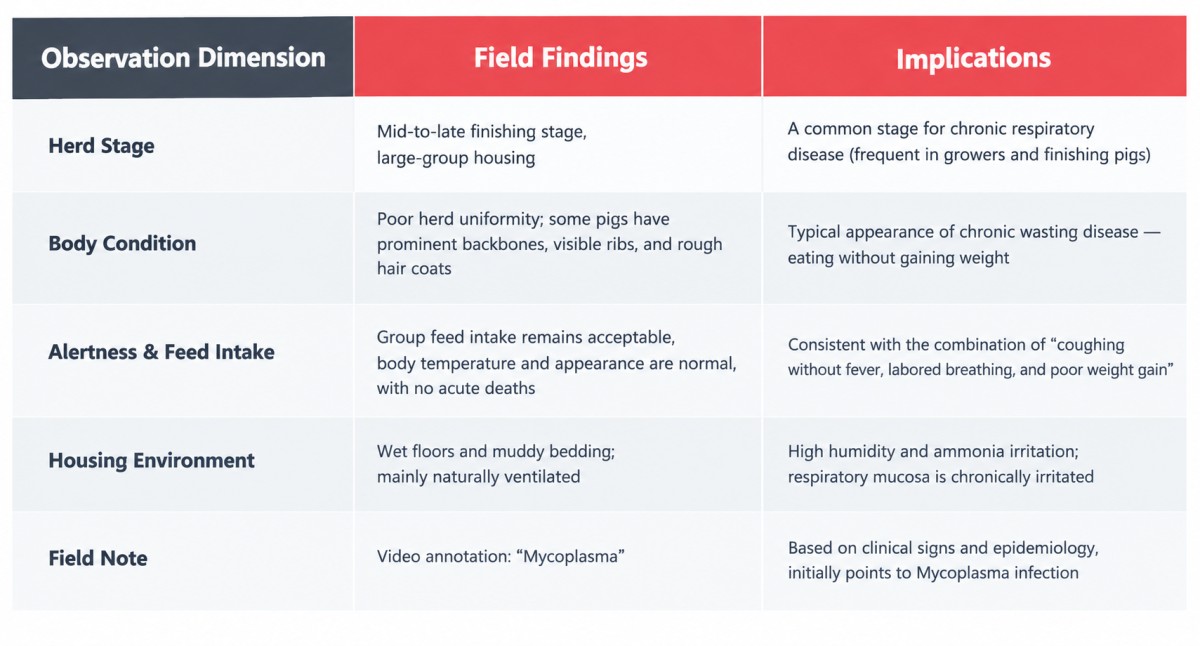
However, two core abnormal symptoms gradually became prominent within two weeks. First, obvious growth retardation: compared with healthy pigs in the same batch and feeding conditions, the average daily weight gain of affected pigs decreased by 18.7%, the feed conversion ratio increased significantly, and the fattening growth curve was seriously lagging, forming the typical "eat more, grow slower" breeding loss phenomenon. Second, fixed early-morning cough symptoms: affected pigs had sporadic dry, non-productive coughs concentrated in the early morning and low-temperature periods. The cough was mild and intermittent during the day, but worsened significantly after getting up and ventilating in the morning, with no nasal discharge or dyspnea symptoms in the whole process.
After one month of continuous latent infection, individual affected pigs began to show slight dullness of spirit, uneven body condition, and rough coat. The farm initially judged it as common cold stress or mild environmental stimulation and adopted conventional anti-inflammatory and antitussive treatment schemes, but the symptoms did not improve. Instead, the number of infected pigs gradually increased, showing typical group infection characteristics of Mycoplasma hyopneumoniae.
2. Laboratory Diagnosis and Pathological Analysis
To confirm the pathogen and avoid misdiagnosis, the farm cooperated with a professional animal disease detection institution to carry out systematic sampling and testing. Throat swabs and lung tissue samples of affected pigs were collected for PCR pathogen detection and pathological section observation. The test results confirmed that Mycoplasma hyopneumoniae was positive, and no secondary infection of common bacteria such as pleuropneumonia and streptococcus was detected, which ruled out complex respiratory syndrome infection.
Pathological autopsy showed typical mycoplasma pneumonia lesions: the cranial and ventral lobes of the pig lungs showed symmetrical grayish-purple consolidation areas, the lung tissue was stiff and inelastic, and the bronchial cavity contained a small amount of foamy exudate. Different from acute bacterial pneumonia, there was no obvious abscess or massive hemorrhage in the lungs, which verified the characteristics of chronic latent infection of mycoplasma. As mycoplasma has no cell wall structure, conventional beta-lactam antibiotics are completely ineffective against it, which is the fundamental reason why the farm’s previous conventional treatment failed.
Combined with clinical symptoms and test results, the case was finally diagnosed as chronic porcine mycoplasma pneumonia in finisher pigs. The core causes of the outbreak were summarized as follows: long-term low-temperature and humid breeding environment, insufficient early warning of latent infection, and lack of targeted regular mycoplasma prevention and control programs, resulting in the persistent colonization and proliferation of mycoplasma in the respiratory tract of finisher pigs.
3. Targeted Intervention Scheme with Vibov Professional Products
After confirming the diagnosis, the farm officially adopted the Vibov integrated mycoplasma prevention and control solution tailored for finisher pigs, abandoning the previous blind broad-spectrum drug use mode. Vibov’s technical team formulated a targeted segmented intervention scheme according to the chronic latent characteristics of the case, focusing on sterilization and anti-inflammation, repairing respiratory tract damage, improving growth performance, and preventing recurrent infection, with precise dosage and cycle management.
4.1 Core Antibacterial and Anti-Mycoplasma Intervention
Vibov’s special formula product for swine respiratory diseases adopts high-purity targeted anti-mycoplasma active ingredients, which can efficiently penetrate the cell membrane of Mycoplasma hyopneumoniae, inhibit bacterial protein synthesis, and achieve rapid bacteriostasis and sterilization. Different from ordinary single antibiotics, Vibov’s product adds unique anti-inflammatory and lung-protecting factors, which can effectively improve lung consolidation lesions while eliminating pathogens, and solve the problem of persistent cough caused by inflammatory residue. In this case, after 3 consecutive days of targeted administration according to the pig weight ratio, the early-morning cough symptoms of affected pigs were significantly relieved, and the intermittent cough completely disappeared on the 5th day.
4.2 Respiratory Tract Repair and Growth Performance Improvement
The core loss of mycoplasma infection in finisher pigs lies in long-term growth inhibition. Long-term respiratory inflammation will affect the pig’s oxygen absorption and nutrient metabolism efficiency, resulting in "normal feeding but no weight gain". Vibov finisher pig health products are compounded with high-efficiency growth-promoting factors and immune enhancers, which can repair damaged bronchial and alveolar tissues, restore normal respiratory and metabolic functions, and significantly improve feed digestion and utilization rate. In this case, after 7 days of continuous medication and conditioning, the average daily weight gain of affected pigs returned to the normal level of the same batch of healthy pigs, and the feed conversion rate increased by 16.2%, completely solving the core problem of slow growth and weight stagnation.
4.3 Recurrence Prevention and Herd Immunity Enhancement
A major difficulty in swine mycoplasma pneumonia control is high recurrence rate. Latent mycoplasma is easy to re-proliferate when the environment changes or pig immunity declines. Vibov’s solution focuses on both treatment and prevention. While eliminating existing pathogens, it can significantly improve the non-specific immunity of pig herds, form a long-term respiratory immune barrier, inhibit the colonization of residual mycoplasma, and avoid repeated outbreaks of the disease. After the completion of the treatment cycle, the farm continued to use Vibov’s regular prevention program for 2 weeks. During the 3-month follow-up observation, no recurrent cough and growth retardation symptoms occurred in the pig herd, and the health status remained stable.
5. Case Summary and Industry Guidance
This typical finisher pig mycoplasma case fully reflects the common pain points of global pig breeding: chronic latent respiratory diseases are easily misdiagnosed, and long-term hidden infections cause huge economic losses that are often ignored by farmers. The two core symptoms of normal feed intake but stunted growth and early-morning persistent cough are the key identification markers of mild chronic mycoplasma infection in finisher pigs. Farmers should abandon the single judgment standard of "fever and lethargy as illness" and establish a precise daily health monitoring mechanism.
In terms of disease control, blind use of conventional antibiotics is the main reason for poor treatment effect and drug resistance. Vibov, as a professional global livestock health brand focusing on swine disease prevention and control, has always been committed to developing targeted, efficient, and low-residue breeding health solutions. For porcine mycoplasma pneumonia, Vibov’s integrated scheme has three core advantages in practical application: accurate targeting of mycoplasma pathogens to solve the problem of ineffective conventional drugs; dual effects of anti-inflammation and tissue repair to eliminate clinical symptoms and lesion damage; and integration of treatment and prevention to reduce disease recurrence rate and breeding loss.
At present, Vibov’s swine mycoplasma control products have been widely promoted and applied in pig farms in Europe, North America, Southeast Asia and other global regions, helping numerous breeding enterprises effectively solve hidden respiratory health problems, significantly improve pig herd growth performance and breeding economic benefits. In the future, Vibov will continue to focus on the pain points and difficulties of global livestock breeding, rely on professional R&D technology and rich field experience, and provide more scientific, efficient and reliable health solutions for the global animal husbandry industry.
Previous:No more content
Next:No more content